
Research
5. Prevention of dry eye by meibum lipids
Although not widely recognized, a lipid layer is present at the outermost surface of the tear film (Figure 14A). This layer plays important roles, including suppressing evaporation of water, lowering surface tension, and conferring appropriate viscoelasticity to the tear film. The portions of the tear film other than the lipid layer have traditionally been divided into the “aqueous layer” and the “mucin layer.” However, because there is no clear boundary between them, they are now often collectively referred to as the “muco-aqueous layer.” The lipids constituting the lipid layer are primarily derived from the meibomian glands in the tarsal plates of the eyelids and are collectively referred to as meibum lipids. In contrast, the aqueous components are secreted from the lacrimal glands. Mucins are mainly secreted by goblet cells in the conjunctival epithelium, and membrane-associated mucins are also expressed on the corneal surface.
In recent years, the number of patients with dry eye has increased, partly due to changes in lifestyle, such as the widespread use of computers and smartphones and increased use of air conditioning. Dry eye is broadly classified into aqueous-deficient and evaporative types, with the latter accounting for the majority of cases and, together with mixed-type cases, representing approximately 80% of all patients. Evaporative dry eye is caused by abnormalities in the tear film lipid layer and is most commonly associated with meibomian gland dysfunction, such as obstruction of the gland orifices and atrophy or dropout of the glands. However, currently available treatments for dry eye target only the aqueous and mucin layers, and no therapies specifically targeting the lipid layer are available.
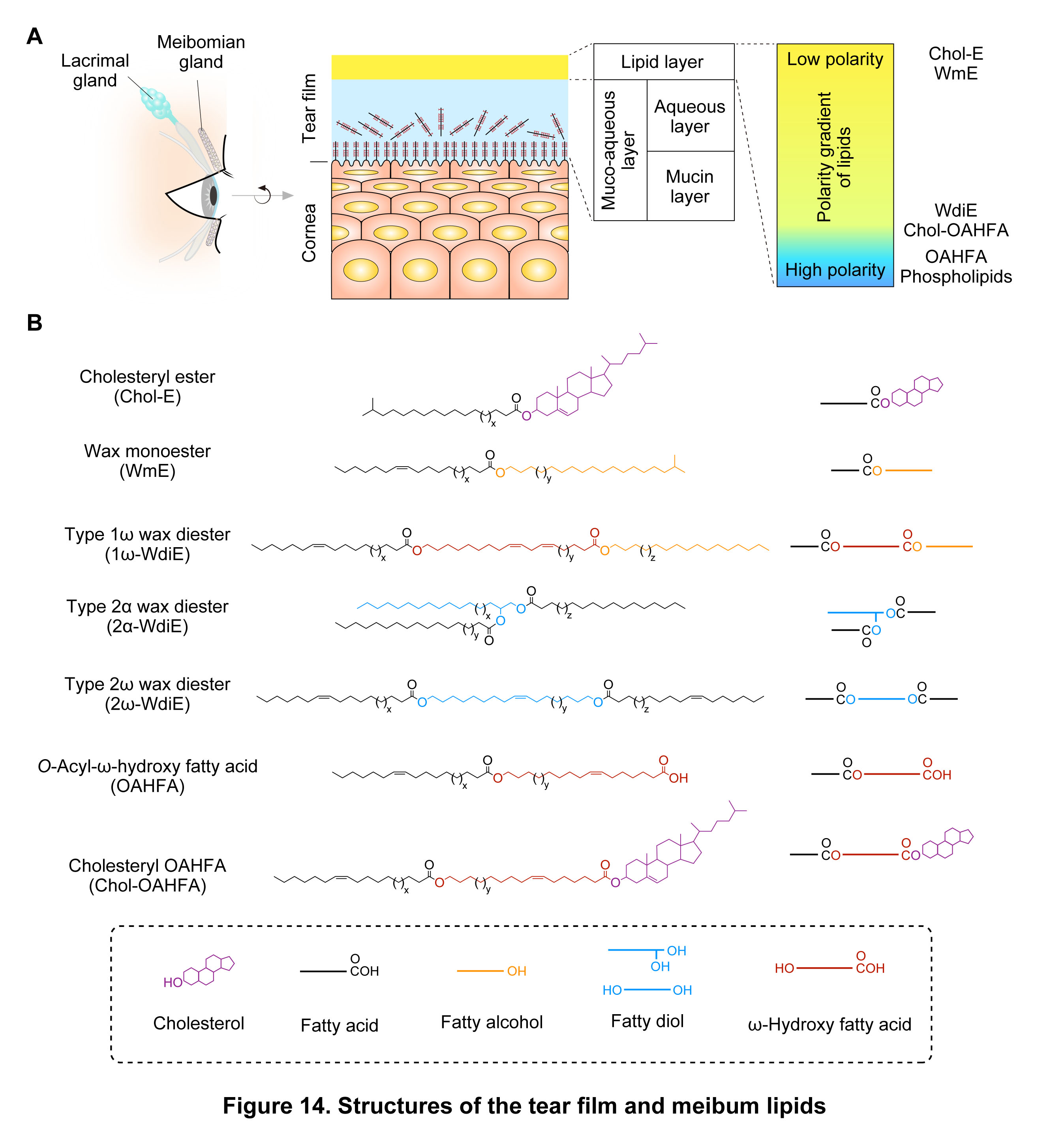
The major components of meibum lipids are the nonpolar cholesteryl esters (Chol-Es) and wax monoesters (WmEs) (Figure 14B). Chol-Es are esters of cholesterol and fatty acids with fatty acyl chains predominantly of C22–C34. In contrast, WmEs consist of fatty acids esterified to fatty alcohols, which are typically C24–C32 in length. Thus, the hydrocarbon chains of Chol-Es and WmEs belong to the very long-chain to ultra-long-chain category. Our interest in meibum lipids was initiated by the observation that Tg-Elovl1 knockout (KO) mice exhibit a dry eye phenotype associated with the shortening of these hydrocarbon chains (for details, see below and “3. Production, functions, and pathology of very-long-chain fatty acids”).
In addition to Chol-Es and WmEs, meibum lipids also include other specialized lipid classes such as wax diesters (WdiEs), O-acyl-ω-hydroxy fatty acids (OAHFAs), and cholesteryl OAHFAs (Chol-OAHFAs) (Figure 14B). WdiEs are classified into type 1 and type 2: type 1 forms contain hydroxy fatty acids esterified at the carboxyl group with a fatty acid and at the hydroxyl group with a fatty alcohol, whereas type 2 forms comprise fatty diols with both hydroxyl groups esterified with fatty acids. Furthermore, these WdiEs are subdivided into α-type (type 1α and type 2α) and ω-type (type 1ω and type 2ω) according to the position of the hydroxyl group. In addition to meibum-derived lipids, the tear film lipid layer also contains phospholipids such as lysophosphatidylcholine, phosphatidylcholine, and sphingomyelin. While Chol-Es and WmEs are nonpolar, OAHFAs and phospholipids are amphipathic. WdiEs and Chol-OAHFAs exhibit intermediate polarity between the nonpolar lipids and the amphipathic lipids. Based on these polarity differences, we propose a lipid polarity gradient model in which amphipathic OAHFAs and phospholipids are localized at the innermost region of the lipid layer near the interface with the muco-aqueous layer, followed by WdiEs and Chol-OAHFAs, with Chol-Es and WmEs occupying the outermost region1) (Figure 14A). Such a continuous polarity gradient is thought to enable water and lipids, which are inherently immiscible, to be stably maintained within the tear film without forming a distinct interface.
At the time we initiated our studies on meibum lipids (2016), much remained unclear about meibum lipids. Major unresolved questions included the genes responsible for the biosynthesis of individual lipid classes, the classification of WdiEs into types, and the detailed species composition of most meibum lipids. To address these issues, we established an analytical method based on liquid chromatography-tandem mass spectrometry (LC-MS/MS) and revealed the previously uncharacterized WdiE types as well as the species within each meibum lipid class (for details, see “LC-MS/MS analysis of meibum lipids” and “Detailed species composition of meibum lipids” below). These analyses revealed that meibum lipids comprise a far greater number of species than previously anticipated. Except for Chol-Es, meibum lipids contain two or three hydrocarbon chains, and the numerous combinations of chain lengths greatly expand diversity, leading to an estimated several hundred to several thousand species within each lipid class. As genes involved in the biosynthesis of meibum lipids, we identified ELOVL1, AWAT1, AWAT2, CYP4F22/39, and FAR2. Furthermore, we generated knockout (KO) mice for each gene and found that all of these mice exhibited a dry eye phenotype, albeit to varying degrees (for details, see “Enzymes and genes involved in meibum lipid biosynthesis” below).
LC-MS/MS analysis of meibum lipids
Meibum lipids were analyzed by LC-MS/MS in multiple reaction monitoring (MRM) mode using a triple quadrupole mass spectrometer coupled with a reverse-phase column. For details on the principles, methods, and considerations, see “Lipid analysis by LC-MS/MS” in “Section 4. Skin barrier formation by ceramides”.
One reason why the types of WdiEs in meibum lipids had remained unclear prior to our studies was the absence of lipid standards corresponding to each type. To address this, we chemically synthesized type 1ω WdiE (1ω-WdiE), type 2α WdiE (2α-WdiE), and type 2ω WdiE (2ω-WdiE) and used them to optimize LC-MS/MS conditions1, 2).
Meibum lipids, particularly WmEs and WdiEs, include many species with identical mass and hydrophobicity, which cannot be separated by LC-MS alone. For example, a C32:1 WmE species (total carbon number 32, one double bond) includes a species composed of a C16:1 fatty acid and a C26:0 fatty alcohol (C16:1/C26:0), but cannot be distinguished from other species with the same total carbon number and degree of unsaturation (e.g., C18:1/C24:0). In WdiEs, even more species share identical mass and hydrophobicity. Therefore, LC-MS/MS is essential for their separation. In LC-MS/MS operating in MRM mode, individual species can be distinguished by setting Q3 values specific to each species, allowing discrimination of the distinct species within C32:1 WmEs. In contrast, 2α-WdiE and 2ω-WdiE, which have identical mass, exhibit the same Q1 and Q3 values and thus cannot be distinguished by MRM alone; however, they can be separated by LC based on differences in hydrophobicity1). Using this approach, we established a high-precision analytical method by optimizing retention time, Q1 and Q3 values, and collision energy for each species, leading to a comprehensive characterization of meibum lipid composition in mice and humans (for details, see below).
Detailed species composition of meibum lipids
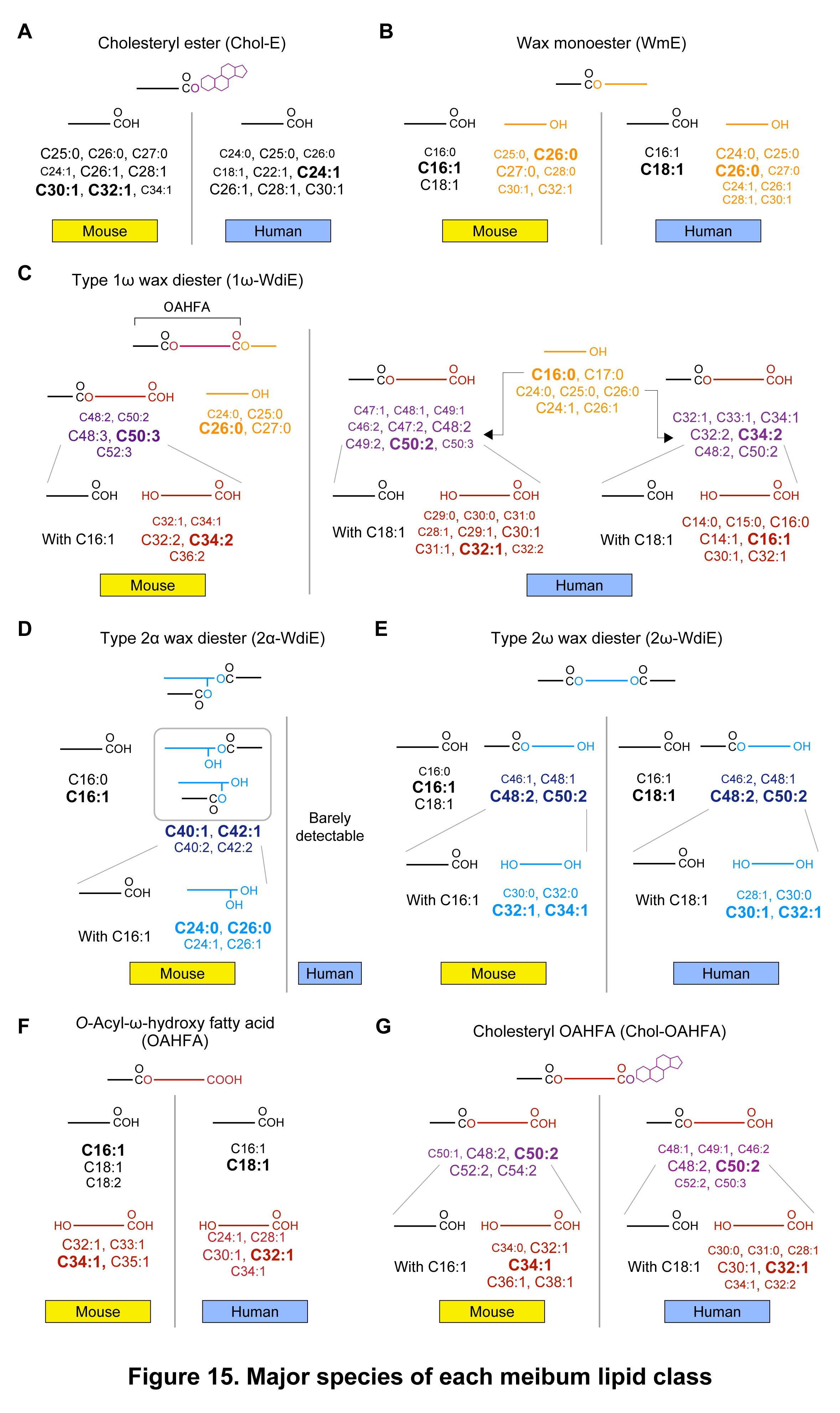
Here, we present the detailed species composition of each meibum lipid class in mice and humans. Human meibum was collected by applying Sebutape Skin Indicator to the orifices of the meibomian glands. For mice, meibum lipids were extracted from the eyelids or from meibomian glands anatomically isolated from the eyelids. Although humans and mice share largely similar lipid classes in meibum lipids, differences were observed both in WdiE types and in overall species composition. First, 2α-WdiE was present in mice, but almost no 2α-WdiE was detected in humans. Second, C16:1 (palmitoleic acid) and C18:1 (oleic acid) are the major fatty acid moieties in many meibum lipid classes in both mice and humans; C16:1 predominates in mice, whereas C18:1 predominates in humans. Third, 1ω-WdiEs are more diverse in humans than in mice. The diversity of 1ω-WdiEs in humans may compensate for the near absence of 2α-WdiEs. Fourth, structural moieties other than fatty acids are in most cases approximately two carbons shorter in humans than in mice. Detailed species for each meibum lipid class are described below. In Figure 15, the chain lengths of major species in each class are represented using four levels of font size according to their relative abundance (the most abundant species are shown in bold and in the largest font size), although many additional species with diverse chain lengths are present but are not shown in the figure for simplicity. For further details on the species composition of each lipid class, see our studies on which this description is based (human meibum lipids3), mouse Chol-Es4), WmEs4, 5), 1ω-WdiEs2, 4), 2α-WdiEs1, 2, 4), 2ω-WdiEs1, 2, 4), OAHFA 1, 2), and Chol-OAHFAs1, 2, 4))
Cholesteryl esters (Chol-Es)
The fatty acid moieties of Chol-Es are predominantly branched at the ω-terminal position (iso and anteiso forms)6) and are either saturated or monounsaturated. Saturated fatty acids are mainly even- and odd-numbered C24:0–C27:0 chains (Figure 15A). In contrast, monounsaturated fatty acids are predominantly even-numbered C24:1–C34:1 chains. The major species are C30:1 and C32:1 in mice and C24:1 in humans.
Wax monoesters (WmEs)
The fatty acid moieties of WmEs are predominantly C16:1 and C18:1. The fatty alcohol moieties are predominantly branched at the ω-terminal position (iso and anteiso forms)6) and are either saturated or monounsaturated. Saturated fatty alcohols are mainly even- and odd-numbered C24:0–C28:0 chains (Figure 15B). In contrast, monounsaturated fatty alcohols are predominantly even-numbered C24:1–C32:1 chains. The most abundant species have C26:0 alcohol moieties in both mice and humans.
Type 1ω wax diesters (1ω-WdiEs)
Among WdiEs, 1ω-WdiEs are diesters composed of three hydrocarbon chains: a fatty acid, an ω-hydroxy fatty acid, and a fatty alcohol. In LC-MS/MS operating in MRM mode, information can be obtained for only two structural components because Q1 and Q3 are set to the m/z values of precursor and product ions. Analysis of all three hydrocarbon chains would require LC-MS/MS/MS, which cannot be performed with the triple quadrupole mass spectrometer used in our study. Therefore, 1ω-WdiEs were analyzed by setting Q1/Q3 values corresponding to two components, namely the fatty acid plus the ω-hydroxy fatty acid (i.e., OAHFAs) and the fatty alcohol. Whereas species composition is largely similar between mice and humans for most other meibum lipid classes, 1ω-WdiEs show a modest difference, with greater diversity in humans. In particular, both the OAHFA moieties and the fatty alcohol moieties in humans include shorter-chain species that are not observed in mice.
In mice, the fatty alcohol moieties of 1ω-WdiEs are predominantly saturated C24:0–C27:0 chains, with C26:0 being the most abundant (Figure 15C). In contrast, the OAHFA moieties predominantly comprise even-numbered C48–C52 species containing di- and triunsaturated chains, among which C50:3 is the most abundant. Although the composition of the fatty acid and ω-hydroxy fatty acid within the OAHFA moiety has not been directly determined, given that most fatty acid moieties in meibum lipids (except Chol-Es) are C16:1 and C18:1, with C16:1 being predominant in mice, the ω-hydroxy fatty acid moieties are estimated to be mainly monounsaturated and diunsaturated C32–C36 chains, with C34:2 being the most abundant.
In humans, the fatty alcohol moieties of 1ω-WdiEs are more diverse than in mice. In addition to saturated very long-chain C24:0–C26:0 alcohols also present in mice, saturated long-chain C16:0 and C17:0 as well as monounsaturated very long-chain C24:1 and C26:1 alcohols are also present. Among these, species containing C16:0 are the most abundant. Such relatively shorter-chain saturated fatty alcohol moieties represent a characteristic feature of human 1ω-WdiEs. In 1ω-WdiEs containing C16:0 fatty alcohol moieties, the OAHFA moieties predominantly comprise even-numbered C46–C50 species with monounsaturated, diunsaturated, and triunsaturated chains, among which C50:2 is the most abundant. Assuming that the fatty acid moiety is C18:1, which is predominant in humans, the ω-hydroxy fatty acid moieties are estimated to be mainly saturated, monounsaturated, and diunsaturated C28–C32 chains, with C32:1 being the most abundant. In contrast, in 1ω-WdiEs containing C26:0 fatty alcohol moieties, two clusters of OAHFA species with different chain lengths are observed: even-numbered C32–C34 species (monounsaturated and diunsaturated) and C48–C50 species (diunsaturated). The shorter cluster is not observed in mice. Assuming that the fatty acid moiety is C18:1, these clusters are estimated to contain ω-hydroxy fatty acid moieties of C14–C16 and C30–C32, respectively.
In the above analysis of 1ω-WdiEs in human meibum, measurements were focused on C16:0 and C26:0 fatty alcohol moieties and the C50:2 OAHFA moiety because the number of possible combinations of fatty alcohol and OAHFA moieties is extremely large. Although the description above was limited to relatively abundant species, many additional species were actually detected. For example, approximately 70 species of 1ω-WdiEs containing C16:0 or C26:0 fatty alcohol moieties were detected based on differences in the OAHFA moiety. In addition, approximately 40 species of 1ω-WdiEs containing the C50:2 OAHFA moiety were detected based on differences in the fatty alcohol moiety. These results suggest that the combinations of fatty alcohol and OAHFA moieties in human meibum may reach up to 70 × 40 = 2,800. Furthermore, considering that up to 10 combinations of fatty acid and ω-hydroxy fatty acid moieties may exist within the OAHFA moiety, the total number of possible 1ω-WdiE species is estimated to be 2,800 × 10 = 28,000. Even assuming that the actual number is approximately one-tenth of this estimate, about 2,800 1ω-WdiE species are present in meibum.
Type 2α wax diesters (2α-WdiEs)
Although 2α-WdiEs are present in mice, they were hardly detected in humans. These WdiEs are diesters composed of a fatty diol (1,α-fatty diol) and two fatty acids. In our LC-MS/MS analysis in MRM mode, 2α-WdiEs were analyzed as two components: one fatty acid and the remaining diol–fatty acid ester moiety. The positions of the two fatty acids on the fatty diol cannot be distinguished using our analytical system. The fatty acid moieties are predominantly C16:1, followed by C16:0 (Figure 15D). The diol–fatty acid ester moieties predominantly comprise even-numbered C40 and C42 species with monounsaturated and diunsaturated chains, among which C40:1 and C42:1 are the most abundant. Assuming that the fatty acid moiety is C16:1, the fatty diol moieties are estimated to be mainly saturated and monounsaturated C24 and C26 chains, with C24:0 and C26:0 being the most abundant.
Type 2ω wax diesters (2ω-WdiEs)
The composition of 2ω-WdiEs is largely similar between mice and humans. Structurally, 2ω-WdiEs are diesters composed of a 1,ω-fatty diol and two fatty acids. In our LC-MS/MS analysis in MRM mode, 2ω-WdiEs were analyzed as two components, as in the case of 2α-WdiEs: one fatty acid and the remaining diol–fatty acid ester moiety. In both mice and humans, the fatty acid moieties are predominantly C16:1 and C18:1. The diol–fatty acid ester moieties are mainly monounsaturated or diunsaturated even-numbered C46–C50 species, among which C48:2 and C50:2 are the most abundant (Figure 15E). Assuming that the fatty acid moieties are C16:1 in mice and C18:1 in humans, the 1,ω-fatty diol moieties are estimated to be mainly saturated and monounsaturated C30–C34 chains in mice and C28–C32 chains in humans, with C32:1/C34:1 and C30:1/C32:1 being the most abundant, respectively.
O-Acyl-ω-hydroxy fatty acids (OAHFAs)
OAHFAs consist of a fatty acid and an ω-hydroxy fatty acid. The composition of OAHFAs in meibum is largely similar between humans and mice, with several notable differences. The fatty acid moieties are predominantly C16:1 and C18:1, whereas the ω-hydroxy fatty acid moieties are mainly monounsaturated C32:1–C35:1 species in mice and C28:1–C34:1 species in humans, with C34:1 and C32:1 being the most abundant, respectively (Figure 15F). OAHFAs containing C18:2 fatty acids were also detected in mice; however, these are unlikely to be produced by meibocytes and may instead originate from degradation products of acylceramides derived from epidermal or epithelial cells present in the meibomian glands1). A characteristic feature of human OAHFAs is the relatively high abundance of species containing a shorter ω-hydroxy fatty acid, such as C24:1. Given that the substrate of CYP4F22, which catalyzes ω-hydroxylation, is fatty acids of ≥C287), the C24:1 ω-hydroxy fatty acid is likely produced by an enzyme other than CYP4F22.
Cholesteryl OAHFAs (Chol-OAHFAs)
Chol-OAHFAs are diesters composed of cholesterol and an OAHFA moiety (a fatty acid and an ω-hydroxy fatty acid). The composition of Chol-OAHFAs is similar between mice and humans. The OAHFA moieties are mainly mono-, di-, and triunsaturated even-numbered C48–C54 species in mice and C46–C52 species in humans, with diunsaturated species being predominant (Figure 15G). The most abundant species is C50:2 in both mice and humans. Assuming that the fatty acid moiety of OAHFAs is C16:1 in mice and C18:1 in humans, the ω-hydroxy fatty acid moieties are estimated to be saturated, monounsaturated, and diunsaturated C32–C38 chains in mice and C28–C34 chains in humans, with monounsaturated species being predominant and C34:1 (mice) and C32:1 (humans) being the most abundant.
Summary of hydrocarbon chain lengths in meibum lipids
The compositions of the individual meibum lipid classes reveal common patterns in the lengths of constituent hydrocarbon chains. Fatty acid moieties are predominantly C16:1 or C18:1, with C16:1 being more abundant in mice and C18:1 in humans (except for Chol-Es). Fatty alcohol and 1,2-fatty diol moieties are mainly C24:0 and C26:0. In contrast, ω-hydroxy fatty acid and 1,ω-fatty diol moieties are predominantly monounsaturated or diunsaturated C30, C32, and C34 chains, with C34 being most abundant in mice and C32 in humans. These chain-length patterns of ω-hydroxy fatty acid and diol moieties are consistent with the substrate specificity of the ω-hydroxylases CYP4F22 in humans and CYP4F39 in mice, which exhibit high activity toward fatty acids with chain lengths of ≥C287).
Enzymes and genes involved in meibum lipid biosynthesis
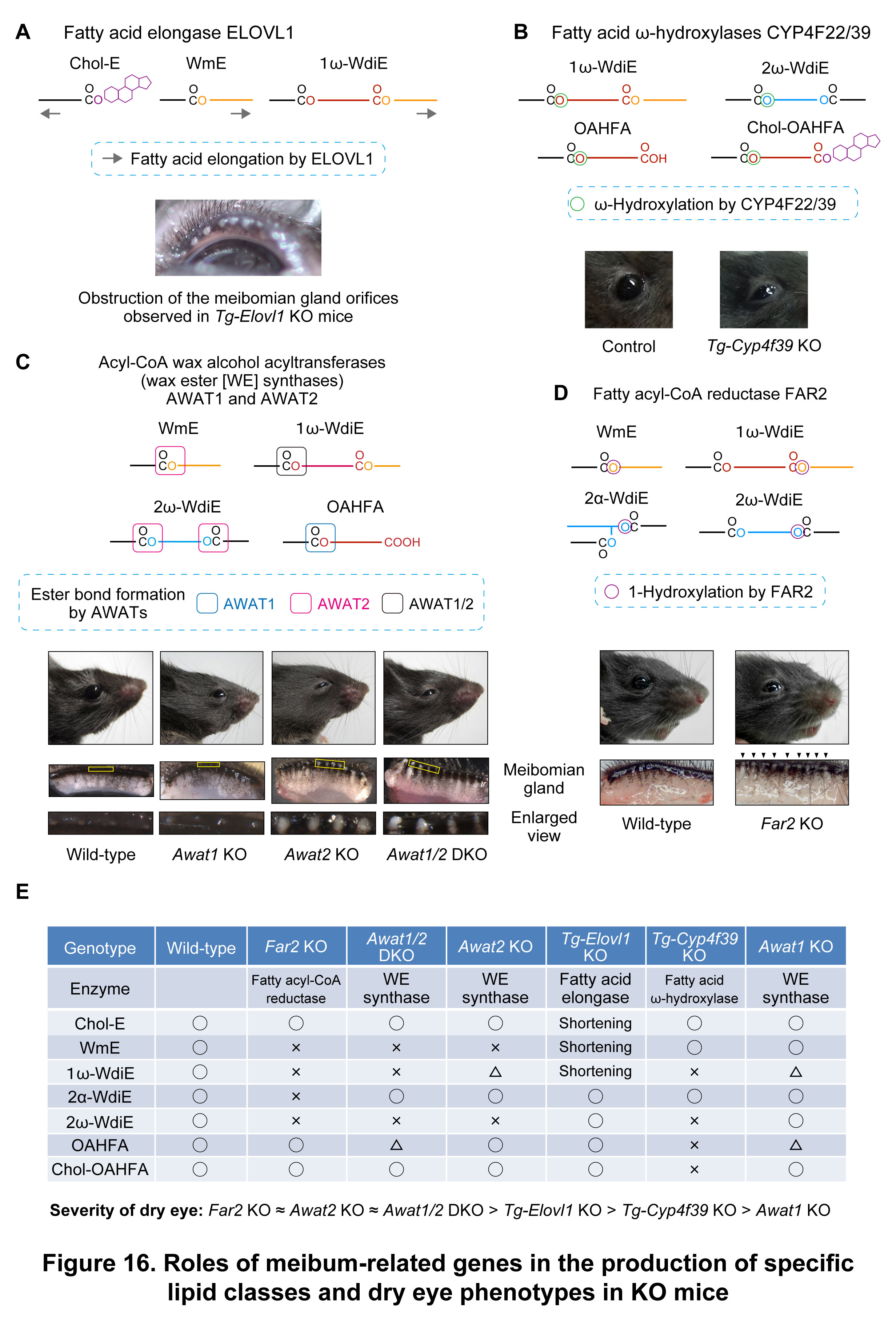
Figure 16 presents the enzymes and genes identified in our laboratory that are involved in the biosynthesis of meibum lipids, together with the lipid classes to which they contribute and the dry eye phenotypes observed in mice lacking these genes. Detailed descriptions of each enzyme and gene are provided below.
Fatty acid elongase ELOVL1
ELOVL1 is also described in “Section 4. Ceramide-mediated skin barrier formation.” Our laboratory showed that mice lacking Elovl1 in non-epidermal tissues, while retaining its expression in the epidermis8) (Tg-Elovl1 KO mice), exhibit a dry eye phenotype. These mice were designed to overcome neonatal lethality caused by whole-body Elovl1 deficiency due to impaired skin barrier formation, by restoring Elovl1 expression specifically in the epidermis using an involucrin (Inv) promoter-driven transgene. Tg-Elovl1 KO mice exhibit partially closed eyes, increased blinking, enhanced water evaporation from the ocular surface, obstruction of the meibomian gland orifices, and tear film instability (reduced tear breakup time) from an early age, followed by corneal damage after 3 months of age and corneal opacity after 5 months, resembling severe dry eye in humans8, 9) (Figure 16A). LC-MS/MS analysis of meibum lipids revealed shortening of the fatty acid moieties in Chol-Es and of the fatty alcohol moieties in WmEs and 1ω-WdiEs in Tg-Elovl1 KO mice4, 6, 8). These findings indicate that appropriate chain lengths are critical for meibum lipid function and for preventing dry eye.
In Tg-Elovl1 KO mice, Elovl1 is absent from non-epidermal tissues from the developmental stage. To examine the short- and intermediate-term effects of Elovl1 deficiency, our laboratory employed a tamoxifen-inducible Elovl1 conditional knockout (cKO) mouse model4) (as described for this model in “Section 4. Ceramide-mediated skin barrier formation”). Following the start of tamoxifen administration, shortening of meibum lipids was observed from approximately day 5 and became more pronounced by days 10 and 15. In Elovl1 cKO mice, multiple dry eye-related phenotypes, including partially closed eyes, increased blinking, enhanced water evaporation from the ocular surface, obstruction of the meibomian gland orifices, and tear film instability (reduced tear breakup time), were observed from day 10, with some phenotypes becoming more pronounced by day 30. These results indicate that the degree of chain shortening in meibum lipids determines the severity and temporal progression of dry eye phenotypes.
In mouse meibum lipids, the fatty acid moieties of Chol-Es are mainly C25–C34, and the fatty alcohol moieties of WmEs are C25–C32, with branched-chain species (iso and anteiso) being predominant, as described above. Our laboratory demonstrated that the production of these branched lipids involves elongation of branched acyl-CoAs, namely isobutyryl-CoA, isovaleryl-CoA, and 2-methylbutyryl-CoA, derived from branched-chain amino acids. These acyl-CoAs are first extended to long-chain lengths by fatty acid synthase and subsequently elongated to very long-chain lengths by the fatty acid elongases ELOVL3 and ELOVL16).
Fatty acid ω-hydroxylases CYP4F22/CYP4F39
Before our studies, the enzymes responsible for the production of ω-hydroxy fatty acids contained in OAHFAs, Chol-OAHFAs, 1ω-WdiEs, and 2ω-WdiEs were unknown, and the roles of these ω-hydroxylated meibum lipids in the tear film lipid layer were unclear. Our laboratory therefore attempted to identify the gene encoding this enzyme. OAHFAs share a structural similarity with acylceramides, except that the long-chain base is absent, and the acyl group esterified at the ω-position is mainly linoleic acid in acylceramides, whereas it is mainly oleic acid in humans or palmitoleic acid in mice in OAHFAs. Based on this similarity, we hypothesized that CYP4F22 (CYP4F39 in mice), which functions in acylceramide production, is responsible for introducing the ω-hydroxyl group characteristic of OAHFAs. To test this hypothesis, we generated Cyp4f39 mutant mice (Tg-Cyp4f39 KO mice) designed to lack Cyp4f39 in non-epidermal tissues, analogous to Tg-Elovl1 KO mice, and quantified ω-hydroxylated lipids in meibum. In these mice, OAHFAs were reduced to approximately one-fifth of control levels, with Chol-OAHFAs, 1ω-WdiEs, and 2ω-WdiEs being nearly absent1). These results indicate that CYP4F22/CYP4F39 are responsible for the production of most ω-hydroxy fatty acids in meibum lipids (Figure 16B). Tg-Cyp4f39 KO mice exhibited dry eye-related phenotypes, including partially closed eyes, tear accumulation on the lower eyelids, increased blinking, reduced tear breakup time, and corneal epithelial damage.
Acyl-CoA wax alcohol acyltransferases (wax ester synthases) AWAT1 and AWAT2
Many meibum lipids contain ester bonds; however, the acyltransferases responsible for the formation of these ester bonds remained largely unknown. Prior to our study, in vitro analyses had shown that the acyl-CoA wax alcohol acyltransferases AWAT1 and AWAT2 exhibit activity for the production of WmEs using long-chain fatty alcohols as substrates. However, because the fatty alcohols present in meibum lipids are predominantly very long-chain to ultra long-chain, whether these enzymes are involved in their production in vivo remained unclear. To determine the involvement of AWAT1 and AWAT2 in meibum lipid production, our laboratory generated Awat1 KO, Awat2 KO, and Awat1/Awat2 double KO (DKO) mice and analyzed dry eye phenotypes and meibum lipid composition2). Awat2 KO and DKO mice exhibited severe dry eye phenotypes, whereas Awat1 KO mice showed a milder phenotype (Figure 16C). In these mice, selective loss or reduction of specific meibum lipid classes was observed. In Awat1 KO mice, 1ω-WdiEs and OAHFAs were reduced. In Awat2 KO mice, WmEs and 2ω-WdiEs were nearly absent, with a reduction in some 1ω-WdiEs. In DKO mice, all of these lipid classes were almost completely absent. These findings demonstrate that AWAT1 and AWAT2 have distinct substrate specificities and contribute to the production of different classes of meibum lipids.
Fatty acyl-CoA reductase FAR2
Meibum lipids include esterified lipids that contain very-long-chain fatty alcohols and diols, such as WmEs and WdiEs. However, the enzymes responsible for forming the C-1 hydroxyl group remained unknown. To address this, our laboratory focused on the fatty acyl-CoA reductases FAR1 and FAR2, which are known to possess fatty alcohol-producing activity, and investigated their chain length–dependent activities as well as their roles in meibum lipid production. Analyses using cells overexpressing FAR1 or FAR2 revealed that FAR1 and FAR2 produce long-chain and very-long-chain fatty alcohols, respectively10). Furthermore, we generated Far2 KO mice and found that these mice exhibited evaporative dry eye phenotypes, including obstruction of the meibomian gland orifices, increased water evaporation from the ocular surface, and reduced tear breakup time10) (Figure 16D). LC-MS/MS analysis of meibum lipids in Far2 KO mice revealed that WmEs and 1ω-, 2α-, and 2ω-WdiEs were nearly absent. These findings demonstrate that FAR2 is involved in the production of very-long-chain fatty alcohols and diols present in meibum lipids and plays an important role in preventing dry eye.
Summary of lipid compositional changes and dry eye phenotypes in gene KO mice
Figure 16E summarizes the changes in meibum lipid composition and the severity of dry eye in genetically modified mouse models established in our laboratory. The severity of dry eye was highest in Far2 KO, Awat2 KO, and Awat1/Awat2 DKO mice, followed by Tg-Elovl1 KO, Tg-Cyp4f39 KO, and Awat1 KO mice. The severity largely depended on the classes of meibum lipids affected by each gene deficiency. Chol-Es and WmEs are the major components of meibum lipids, and changes in their abundance or chain length led to severe dry eye phenotypes. In Far2 KO, Awat2 KO, and Awat1/Awat2 DKO mice, WmEs were nearly absent. In these mice, the melting point of meibum lipids is elevated, leading to solidification of the lipids and near-complete obstruction of the meibomian gland orifices. In the moderately severe Tg-Elovl1 KO mice, both Chol-Es and WmEs were shortened in chain length. Tg-Cyp4f39 KO mice exhibited relatively mild dry eye, which may be attributed to a reduction in ω-hydroxylated lipids while the levels of Chol-Es and WmEs remain unaffected. The dry eye phenotype in Awat1 KO mice was minimal, with lipid changes limited to reductions in OAHFAs and a subset of 1ω-WdiEs.
Lipid composition of meibum and tear fluid
Our laboratory analyzed the lipid composition not only of meibum but also of human tear fluid. Tear samples were collected using phenol red–impregnated cotton threads. In addition to the meibum lipid classes described above, phospholipids, including phosphatidylcholine and sphingomyelin, were also quantified3). The species composition of each lipid class in meibum and tear fluid was highly similar, except for phosphatidylcholine. When the relative abundance of each lipid class (meibum-to-tear ratio) was calculated, phosphatidylcholine and sphingomyelin showed low ratios, whereas the other lipid classes showed high ratios. These findings suggest that most lipids in the tear film lipid layer are derived from the meibomian glands, whereas phosphatidylcholine and sphingomyelin are likely derived from other tissues, such as the lacrimal gland and corneal epithelium.
Conclusion
As outlined above, our laboratory has obtained a series of novel insights into the structure, composition, and molecular mechanisms of biosynthesis of meibum lipids, as well as their roles in preventing dry eye. Currently available treatments for dry eye primarily target the aqueous and mucin layers of the tear film, whereas these findings are expected to contribute to the development of new eye drops targeting the lipid layer.
References
- Miyamoto M, Sassa T, Sawai M, Kihara A. (2020) Lipid polarity gradient formed by ω-hydroxy lipids in tear film prevents dry eye disease. eLife, 9, e53582.
- Sawai M, Watanabe K, Tanaka K, Kinoshita W, Otsuka K, Miyamoto M, Sassa T, Kihara A. (2021) Diverse meibum lipids produced by Awat1 and Awat2 are important for stabilizing tear film and protecting the ocular surface. iScience, 24, 102478.
- Terai M, Jojima K, Ogawa-Sawai M, Kihara A. (2025) Comprehensive lipid analysis of human meibum and tears. Sci Rep, 15, 35556.
- Tada H, Jojima K, Hiranuma T, Sassa T, Kihara A. (2026) Time-dependent changes in meibum lipid composition and progression of dry eye following disruption of the fatty acid elongase Elovl1. J Biol Chem, 302, 111160.
- Kuribayashi K, Jojima K, Yamamoto M, Takeda M, Kihara A. (2026) Detailed composition of wax esters in mouse sebum and the involvement of FAR2 and AWAT2. iScience, 29, 114836.
- Tanno H, Sassa T, Sawai M, Kihara A. (2021) Production of branched-chain very-long-chain fatty acids by fatty acid elongases and their tissue distribution in mammals. Biochim Biophys Acta Mol Cell Biol Lipids, 1866, 158842.
- Ohno Y, Nakamichi S, Ohkuni A, Kamiyama N, Naoe A, Tsujimura H, Yokose U, Sugiura K, Ishikawa J, Akiyama M, Kihara A. (2015) Essential role of the cytochrome P450 CYP4F22 in the production of acylceramide, the key lipid for skin permeability barrier formation. Proc Natl Acad Sci USA, 112, 7707–7712.
- Sassa T, Tadaki M, Kiyonari H, Kihara A. (2018) Very long-chain tear film lipids produced by fatty acid elongase ELOVL1 prevent dry eye disease in mice. FASEB J, 32, 2966–2978.
- Watanabe K, Yoshida M, Okumura T, Sassa T, Kihara A, Uchiyama A. (2021) Improvement of evaporative dry eye with meibomian gland dysfunction in model mice by treatment with ophthalmic solution containing mineral oil. Transl Vis Sci Technol, 10, 21.
- Otsuka K, Sawai-Ogawa M, Kihara A. (2022) Formation of fatty alcohols-components of meibum lipids-by the fatty acyl-CoA reductase FAR2 is essential for dry eye prevention. FASEB J, 36, e22216.