
Research
6. Barrier formation and hair maintenance by diverse sebum lipids
Sebum has multiple roles, including barrier functions such as moisturization, water repellency, and antimicrobial activity, as well as functions in thermoregulation and hair retention. Changes in its secretion levels and lipid composition are associated with skin disorders, including dry skin, acne, seborrheic dermatitis, and alopecia. Meibomian glands and sebaceous glands belong to the same gland type; therefore, the lipid classes that constitute sebum are similar to those in meibum. Our laboratory performed a detailed analysis of mouse sebum lipids using an LC-MS/MS analytical method established for meibum lipid research.
As described in "Section 5. Prevention of dry eye by meibum lipids", mouse meibum contains several lipid classes, including cholesteryl esters (Chol-Es), wax monoesters (WmEs), wax diesters (type 1ω [1ω-WdiEs], type 2α [2α-WdiEs], and type 2ω [2ω-WdiEs]), O-acyl-ω-hydroxy fatty acids (OAHFAs), and cholesteryl OAHFAs (Chol-OAHFAs). Among the lipid classes we measured, excluding OAHFAs, our measurements indicate that in mouse sebum, 1ω-WdiEs are detected only at levels close to the detection limit, whereas the other lipid classes are present in sufficient amounts for quantification1).
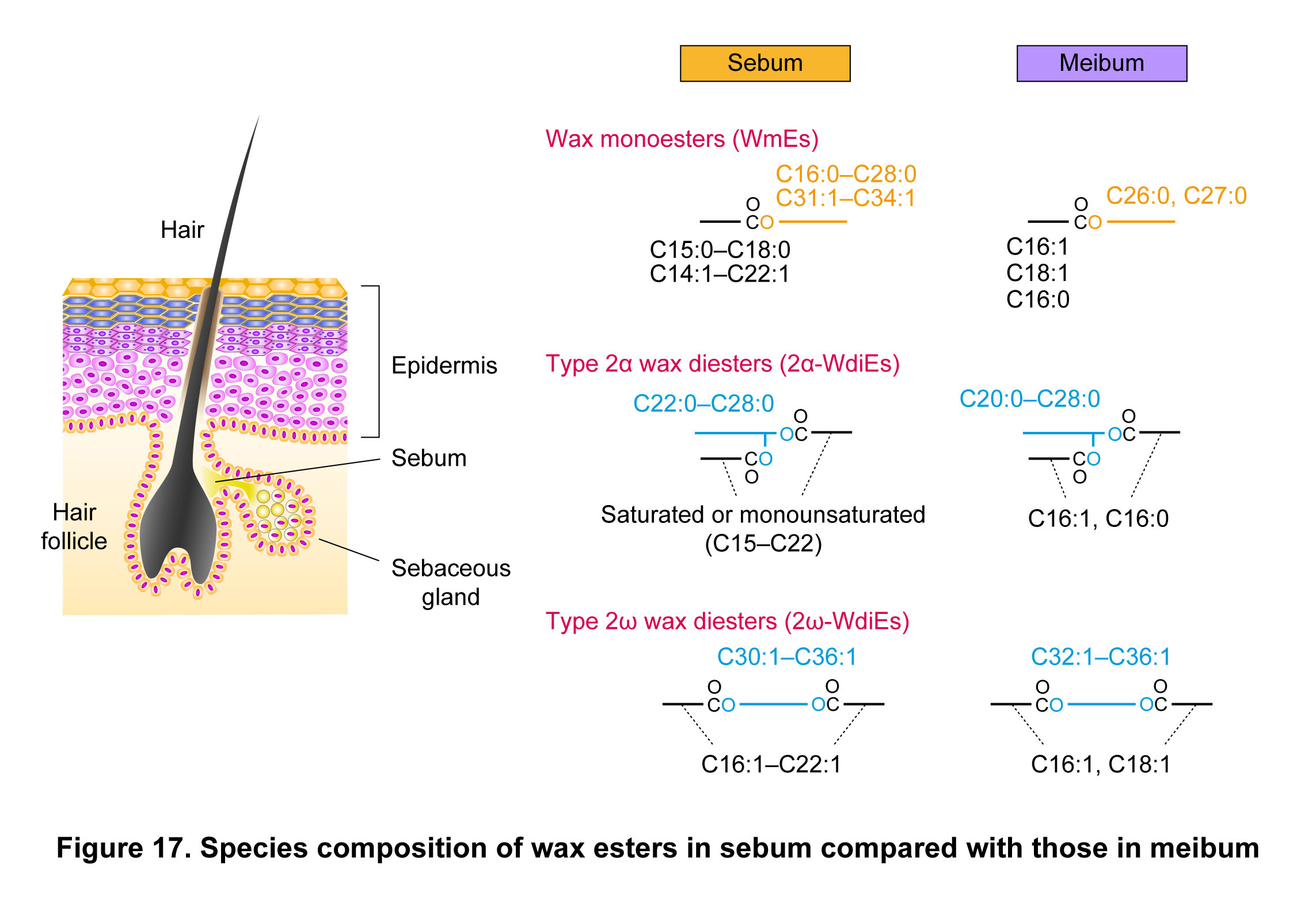
Each lipid class in meibum and sebum consists of multiple hydrocarbon chains, including fatty acids and fatty alcohols that differ in chain length and degree of unsaturation, resulting in multiple species arising from their combinations. The composition of these species differs between meibum lipids and sebum lipids. Sebum lipids exhibit greater diversity in species than meibum lipids (Figure 17). In addition, sebum lipids contain a higher proportion of monounsaturated hydrocarbon chains. For example, in WmEs (esters composed of a fatty acid and a fatty alcohol), the major components in meibum lipids are C16:1, C18:1, and C16:0 as fatty acid moieties and C26:0 and C27:0 as fatty alcohol moieties1). In contrast, in sebum lipids, fatty acid moieties are C15:0–C18:0 and C14:1–C22:1, and fatty alcohol moieties are C16:0–C28:0 and C31:1–C34:1. For WdiEs, the distribution of carbon chain lengths in the fatty acid moieties is broader in sebum lipids than in meibum lipids.
Thus, wax esters (WmEs and WdiEs) in sebum exhibit greater diversity in species than those in meibum. This difference in diversity may be associated with environmental conditions, particularly temperature. Meibum lipids are located in the outermost layer of the tear film, where the temperature is maintained at approximately 32 °C, corresponding to the corneal surface temperature. At this temperature, the tear film lipid layer exhibits a liquid crystalline phase, which contributes to appropriate viscoelastic properties of the tear film. This suggests that the composition of meibum lipids is suited to form a liquid crystalline phase at this temperature. In contrast, sebum on hair and the skin surface is directly exposed to ambient temperature and is exposed to a wide range of temperatures. Sebum is not constrained to a specific phase but instead maintains fluidity over a wide range of temperatures. In general, the phase transition and melting temperature ranges of mixtures are known to broaden as composition diversity increases. The greater diversity of wax esters in sebum may contribute to adaptation to these temperature variations. In addition, the higher content of monounsaturated hydrocarbon chains in sebum wax esters is considered to lower the melting point, thereby helping to resist solidification under low-temperature conditions.
As described in "Section 5. Prevention of dry eye by meibum lipids", in the meibum lipids of Far2 KO mice lacking fatty acyl-CoA reductase (FAR2), WmEs as well as 1ω-WdiEs, 2α-WdiEs, and 2ω-WdiEs are almost absent2). Far2 KO mice, which exhibit dry eye, also show hair loss and partial hair depigmentation1). In the sebum of Far2 KO mice, WmEs with very-long-chain fatty alcohol moieties and 2α-WdiEs and 2ω-WdiEs are greatly reduced compared with those in wild-type mice.
Hair loss is also observed in a subset of Awat2 KO mice lacking acyl-CoA wax alcohol acyltransferase (AWAT2)1). In the sebum of Awat2 KO mice, WmEs and 2ω-WdiEs that contain long-chain fatty acid moieties are reduced compared with those in wild-type mice. These results suggest that AWAT2 is involved in the production of such WmEs and 2ω-WdiEs.
As described above, our laboratory has clarified the detailed composition of sebum lipids. In addition, we identified genes involved in their biosynthesis (FAR2 and AWAT2) and characterized the phenotypes associated with their deficiency, such as hair loss and hair depigmentation. These findings, together with the analytical methods established, are expected to contribute to advancing our understanding of sebum-related disorders and to lead to future diagnostic applications.
References
- Kuribayashi K, Jojima K, Yamamoto M, Takeda M, Kihara A. (2026) Detailed composition of wax esters in mouse sebum and the involvement of FAR2 and AWAT2. iScience, 29, 114836.
- Otsuka K, Sawai-Ogawa M, Kihara A. (2022) Formation of fatty alcohols—components of meibum lipids—by the fatty acyl-CoA reductase FAR2 is essential for dry eye prevention. FASEB J, 36, e22216.